Our Retrospective Journey Of Founding a Motion Design Studio
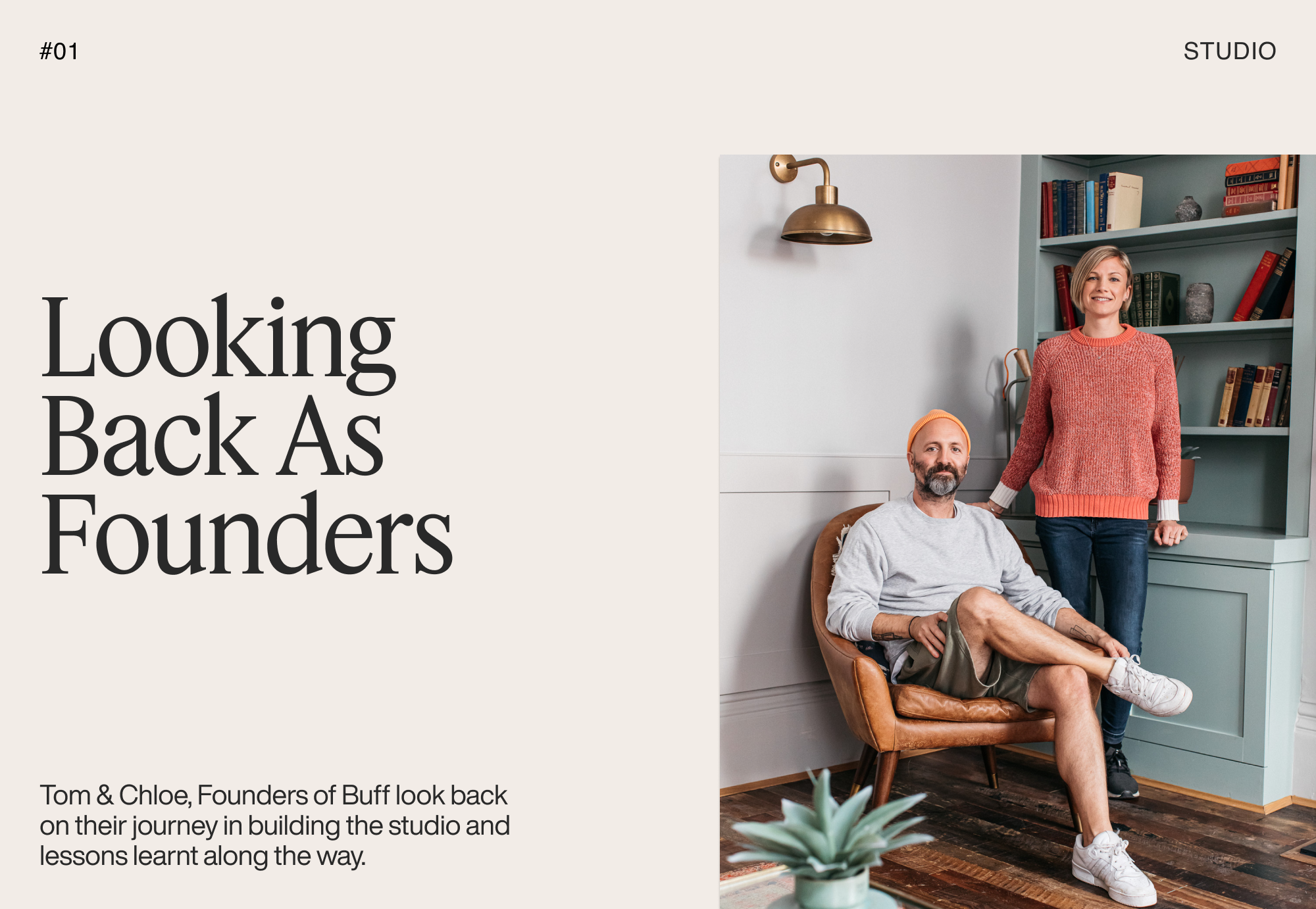
Back in April, Buff celebrated its 8th birthday. It got us thinking about how we managed to get to this point and our story as founders. For anyone reading this that doesn't know us, we founded Buff as equal partners but aren't romantically involved.
We say that up front as it's an important part of what has, at times, been quite an intense journey. Most of the agencies we knew were started by close friends or couples, so diving into a working relationship like this had plenty of unknowns and things to learn.
When we started, neither of us had kids or any experience of running a business and that made it easier to just ‘take a punt’ and try our luck. When we look back, we took the leap without really knowing each other particularly well. But we felt we had the right blend of skills and personalities to make it work. Whilst there have been bumps along the road, we’ve both learnt and changed so much in that time and feel incredibly lucky to have got to this point.
As Buff (and ourselves) have grown and developed, we’ve realised that there are so many areas where we’ve needed to adapt, both professionally and personally. So we decided to write this article as a way to help anyone that is looking to start a business and take that same ‘punt’...
How Buff Started As An Idea
To start from the beginning… Back in early 2014, we had been working together at a video production company just outside London. Within the business, we had been operating the motion-design side of things, Chloe as a Project Manager and Tom as a Motion Designer.
We were starting to run more and more jobs together and in that way, it felt like our own little business within the wider organisation. The shared experience of that company had a huge impact on the type of company we knew we wanted to start. There were growing frustrations that led to us deciding to go out on our own, but also great ideas and concepts that we’ve taken forward and used within Buff. For that opportunity and experience, we’ll always be massively grateful.
The decision to leave came about quickly. It felt like within a couple of days and a few conversations, we had got the ball rolling. Looking back, it was a massive leap. We knew we liked each other as people. We respected and admired the work ethic and skillset of each other, but was that enough to make it work? It felt that way at the time and so without too much thought, we went for it.
At this stage, neither of us were parents. Both of our respective long-term partners were amazingly supportive, particularly as we had no idea when we could start realistically generating money. If we’d had children, it would have made the decision to jump ship and the subsequent months a lot more stressful. On reflection, it may have been the tipping point to never have started Buff.
Ultimately, we were fired up by the idea of taking control of all aspects of what we do: how we charge, who we work for, how we run projects, how we lead a team.
Reminiscing The Early Days
It started off being so freeing to be our own bosses: not ‘having’ to be anywhere, waking up in the morning with a blank canvas. It was exciting but somewhat scary. We were naturally enthusiastic and spent the early days reaching out to potential clients, refining our website and researching the competition and companies we admired. Tom worked on some freelance motion contracts that were invoiced as Buff and those were our only source of income initially. Alongside this, Chloe was putting the business foundations in place (insurance, project documentation, client outreach).
We treated everything from the beginning as an equal partnership, the same as we do today. So regardless of who was actually generating the money, all the other processes and operations were key to put in place and would be an important investment in Buff.
Acknowledging Our Contrasting Skillsets
A big part of the attraction to starting a business together came from us both having very different skillsets and approaches. We knew other small studios that had started with two creatives, some that are still going today. Whilst that setup can absolutely work, we'd question that if by covering the inevitable management of projects a creative would be taken away from what they're good at or enjoy? We felt that by having a partnership with an even split between the client side and creative side, neither of us would have to compromise and we’d be able to focus on what we enjoyed. More importantly, we surmised that we’d be able to offer a more responsive service to our clients because we have an equal focus on both key areas. So when we started, the separation in job roles meant that Tom was focused on the creative output and Chloe took the rest.
We’ve always joked that on reflection this seemed like an unfairly weighted split, but for us, it worked. It meant Chloe was covering the project management, client account management, resourcing/booking freelancers, finance and other operational tasks. We both then shared the new client outreach, contacting companies as and when we saw someone interesting.